The short answer
B2B website speed matters because slow pages lose enquiries before anyone reads your offer. In Portent's 2022 study of B2B lead generation sites, pages that loaded in 1 second converted 3x better than pages that took 5 seconds. Aim for Google's targets: main content visible within 2.5 seconds, clicks answered within 200 milliseconds, and a layout that doesn't jump.
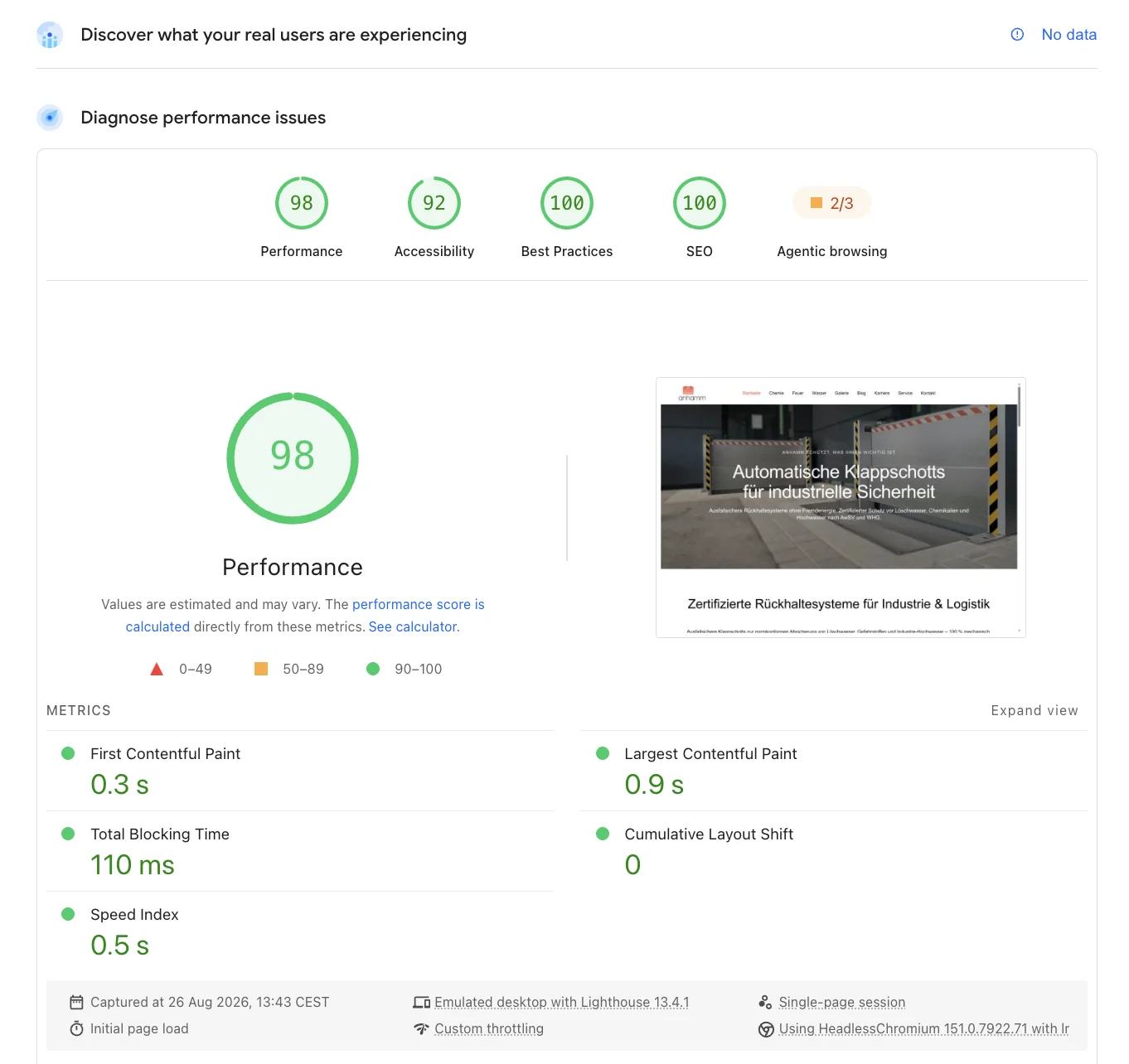
We design and build websites for technical B2B companies. The site we rebuilt for Anhamm, a flood protection manufacturer, scored 98 for desktop performance in a Lighthouse test in August 2026.
The catch with judging your own site is that you open it on office fibre, on a laptop that's visited it 400 times. Your buyer opens it on hotel wifi between two trade show talks, with 31% battery and a coffee in the other hand.
On this page
- Google's speed targets
- Why speed costs B2B leads
- Speed and Google rankings
- What slows a B2B site down
- Lab score vs real visitors
- What we check first
- FAQ
Google's speed targets for a B2B website
| Measure | What it checks | Good score |
|---|---|---|
| Largest Contentful Paint (LCP) | How fast the main content appears | 2.5 seconds or less |
| Interaction to Next Paint (INP) | How fast the page reacts to a click or tap | 200 milliseconds or less |
| Cumulative Layout Shift (CLS) | How much the layout jumps while loading | 0.1 or less |
| Time to First Byte (TTFB) | How fast your server starts answering | 0.8 seconds or less |
The first three are Google's Core Web Vitals, measured at the 75th percentile of real visits, so 3 in 4 visitors need the good experience (web.dev). Server response isn't a Core Web Vital, but a slow one makes the others hard to hit (web.dev on TTFB).
Speed advice goes off like milk, by the way. Anything that still quotes "FID" expired in March 2024, when INP replaced it.
Why is website speed important for B2B companies?
Website speed is important for B2B companies because every extra second cuts the share of visitors who reach your enquiry form. In Portent's data, B2B pages that loaded in 1 second converted at almost 40%, at 2 seconds 34%, and at 3 seconds 29%. Above 5 seconds, conversion roughly halves.
Google and Deloitte's Milliseconds Make Millions study found the same thing in miniature. Making lead generation sites just 0.1 seconds faster on mobile meant 21.6% more visitors reached the form page. A tenth of a second is less time than it takes to regret hitting "reply all".
Manufacturers aren't exempt. When Renault made its main content appear 1 second faster, bounce rate fell by 14 percentage points and conversions rose 13%.
And B2B starts from behind. In Google's 2017 mobile benchmark, US business and industrial sites had the slowest server response of any sector: 2.7 seconds before anything started loading. That's 2.7 seconds of a buyer staring at a white screen, wondering if they typed the address wrong. If yours feels like that, our B2B website design team sets speed as a target from day one, not as a check the night before launch.

Does website speed affect Google rankings?
Yes, but less than most people think. Google says "Core Web Vitals are used by our ranking systems", and also that it "always seeks to show the most relevant content, even if the page experience is sub-par." A fast page with weak content won't beat a slower page that answers the question better.
Google's John Mueller called speed "more than a tie-breaker, but it also doesn't replace relevance". In 2024 he went further: Core Web Vitals "are not giant factors in ranking".
So fix speed for your buyers, not for Google. The ranking bump is small, and the extra enquiries aren't. Chasing a perfect 100 for SEO is like ironing your socks before a job interview. Nobody's checking, and now you're late.
What slows down a B2B website?
On most B2B sites the text and logo aren't the problem. Add-ons are: chat widgets, tag managers, cookie banners, autoplaying hero videos and page builders. The 2024 Web Almanac found 92% of pages load at least one outside tool, with a median of 27 on the top million sites.
| Add-on | Why it slows you down | The fix that keeps it |
|---|---|---|
| Live chat widget | Adds 300 to 600 ms of blocking time on average (CoreWebVitals.io) | Load it after the page, or show a static button that loads chat on click (Chrome docs) |
| Overgrown tag manager | Google sees bigger containers linked to slower clicks (web.dev) | Pause tags nobody reads anymore |
| Cookie banner | Can be the largest thing on a phone screen and shift the layout (web.dev) | Reserve its space and load it without blocking |
| Autoplaying hero video | Google counts it as your main content (web.dev) | A light poster image first, video after |
| Page builder | Deeply nested code; Lighthouse warns above about 800 elements (Chrome docs) | Flatter sections, or a lighter build |
Chat is the classic. On HubSpot's own forum, one user reported that switching chat on "dropped our mobile pagespeed score by an avg of 25 points". That's a lot of points for a little bubble asking "Any questions?" to someone who's had the page open for half a second.
Then there's the hero video. Every manufacturer has one: a drone gliding over the factory roof at golden hour, set to music from a car advert. I get it, it's a lovely roof. But your buyer waits for the roof before they see the product.
Why your PageSpeed score and Google's verdict disagree
Google judges speed on field data: real Chrome visitors over a 28-day window. The big coloured score in PageSpeed Insights is a lab test that loads your page once, with an empty cache. The two often disagree, and only the field data counts for rankings.
Google's Barry Pollard said it best: "a score of 100 doesn't mean perfect; it just means Lighthouse can't help anymore." I still refresh that score the way people refresh a holiday photo they just posted. It's not healthy, and the field data still only moves over 28 days.
Small B2B sites get a twist. If too few Chrome users visit, Google has no field data for you at all, and the Core Web Vitals report in Search Console stays empty. For a niche manufacturer with a few hundred visitors a month, that's normal. Speed then matters for one thing only: whether those few hundred people enquire.

What we check first on a slow B2B website
The Anhamm site is the cleanest example we can show. After the rebuild, a Lighthouse desktop test in August 2026 returned 98 for performance and 100 for both Best Practices and SEO. After about a year of SEO and 3 to 5 expert articles a month, the site brings in about 15 to 20 inbound enquiries a month.
I'd never claim speed did that alone. I'd also never build that system on a slow site.
When I open a slow B2B site, I check three things, in this order:
- The field data, at the top of PageSpeed Insights, before I even look at the score.
- The main content element. If it's a hero video or a giant photo, that's usually the slow part.
- Every outside script, and who still uses it. The honest answer is often a tool from a free trial that ended in 2022.
The drone footage usually survives all three checks. It just gets a poster image and learns some patience. The full Anhamm story is in the Anhamm case study, and if you'd rather hand the whole job over, our B2B website design work plans speed, tracking and enquiry forms together.

FAQ: B2B website speed
What is a good page load time for a B2B website?
Aim for your main content to appear within 2.5 seconds on mobile, Google's "good" threshold for Largest Contentful Paint. Faster is better: in Portent's B2B data, conversion rates fell with every extra second.
Does website speed affect SEO?
Yes. Core Web Vitals are part of Google's ranking systems, but relevance matters more. A fast page that answers the question poorly won't beat a slower page that answers it well.
Does a chat widget slow down my website?
Usually, yes, because it loads scripts while your page is still loading. You can keep chat by loading it after the page finishes, or by showing a static button that only loads the chat when clicked.
Why is my PageSpeed score low when my site feels fast?
The score is a lab test on a simulated phone with an empty cache. You're probably on fast wifi with the site already cached. Check the field data at the top of the report, which reflects real visitors.
Will better hosting make my website faster?
It speeds up the server's first response, which Google rates as good at 0.8 seconds or less. It won't fix a heavy page full of large images, videos and outside scripts.

The bottom line
B2B website speed isn't a vanity score. It decides how many buyers reach your form before their patience runs out, or their battery does.
Check the field data, fix the add-ons, and keep the drone footage. Just let it load second.
Read this next: what happens after the page loads, in our guide to manufacturing lead generation, from the enquiry form to the reply.
Want a B2B website that loads fast and brings enquiries?
We design and build B2B websites with speed, tracking and enquiry forms planned together. See our B2B website design work, or tell us about your site directly.
Discuss Your Growth →Written by Edward R., Founder, Kleosa. Self-employed in e-commerce and digital marketing since 2018, including a year optimising Google Ads accounts for agencies on behalf of Google.