
The short answer
Digital marketing for manufacturers means being findable and convincing at the moment an engineer or buyer researches a problem you solve. In practice that's five connected parts: a website that explains the product, SEO and expert content for your applications, Google Ads on high-intent searches, visibility in AI answers, and fast follow-up on every enquiry.
Why trust us on this: one of our industrial clients, a flood-protection manufacturer, gets about 15 to 20 inbound enquiries a month from a redesigned website and 3 to 5 expert articles a month. As an industrial marketing agency, we build that system for manufacturers with products that need explaining.
On this page
- The five channels
- Content marketing
- Your website
- Where to start
- Lead generation
- SEO and AI search
- Google Ads
- Real client results
- FAQ
The five channels, side by side
| Channel | What it does | First effect |
|---|---|---|
| 1. Website | Turns a visit into an enquiry. Product and application pages, specifications that are easy to find, and a way to ask a question on every page. | The day it launches, because every other channel sends people here. |
| 2. SEO and expert content | Gets you found for the applications you solve, without paying per click. | Measurable visibility within about 3 months in our experience, enquiries growing from there. |
| 3. Google Ads | Reaches buyers whose project is live right now. | Qualified leads within the first month when demand already exists. |
| 4. AI search visibility | Gets your company named when a buyer asks ChatGPT or Google for a shortlist. | Slow, and it builds on the website and content you already have. |
| 5. Follow-up and CRM | Makes sure no enquiry sits in an inbox. | Immediate, it's usually the cheapest fix of the five. |
Why manufacturers need digital marketing now
Your buyers make up their minds before they talk to you. Research from 6sense found that B2B buyers make direct contact with vendors 69% of the way through a buying cycle, and that buyers start the conversation 83% of the time. By the time your phone rings, the shortlist exists, and you're either on it or reading about it in a lost-deal email that's suspiciously polite.
Trade shows still work. So does the sales director who knows every plant manager in three countries. They just don't scale, and the sales director would like to see his family at least once per quarter. Digital marketing is how the 69% of the journey you never see starts including you.
Content marketing for manufacturers: write for the engineer, not the brochure
The content that wins in manufacturing answers a specific technical question better than anyone else. Not "innovative solutions for tomorrow's challenges", which is a sentence that has never once caused a purchase order. Engineers search the application, the tolerance, the standard, the failure they're trying to stop.
In practice: one article per real question your sales team keeps answering by email. If they have explained the same load rating eleven times this year, that isn't a nuisance, it's a content plan. For Anhamm, a steady rhythm of 3 to 5 expert articles a month is part of what keeps about 15 to 20 enquiries a month coming in, alongside the redesigned site. Their full setup is in the Anhamm case study.
"Thanks to Kleosa's systematic approach, we were able to significantly optimize our sales process. The results exactly meet our high standards for quality and efficiency."
Josef Anhamm, Managing Director, Anhamm Liquid Barrier GmbH

Your website is your best sales engineer (if you let it)
Every channel in this guide ends on your website, so it decides whether the money spent upstream turns into enquiries. The usual problem isn't the design. It's that the answer a buyer came for is buried in a 40-page PDF called "Catalogue_2019_final_v3", and nobody downloads that voluntarily.
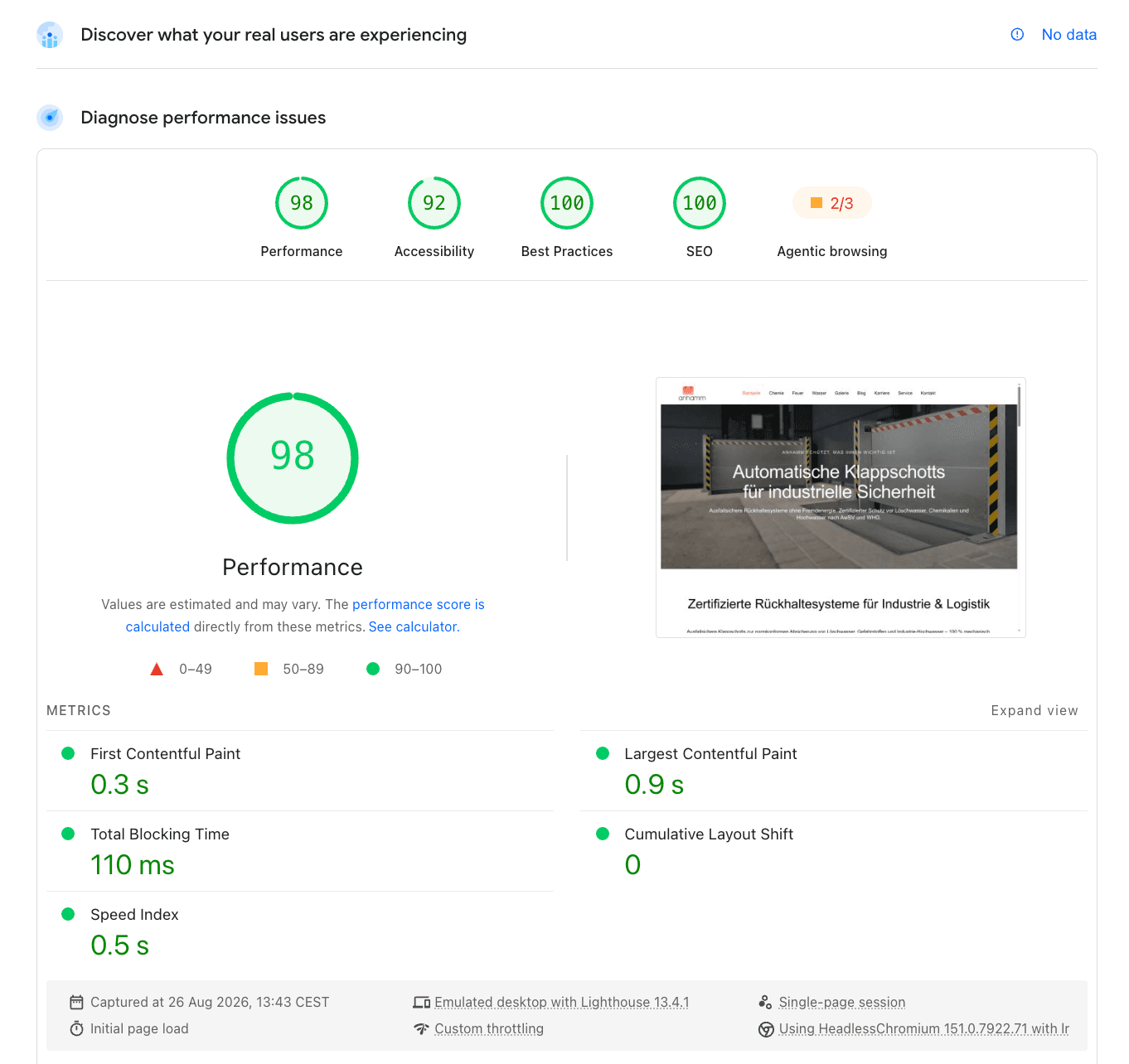
What works: a page per product and per application, specifications in plain text Google can read, and an enquiry path on every page, not just the contact page at the bottom. Speed matters too. Anhamm's rebuilt site scored 98 for desktop performance in Google's Lighthouse test, and if you want the same for your own site, that's our B2B website design work.
Manufacturing marketing strategy: where to start
If I could give manufacturers one piece of advice, it'd be this: start with the product that has the highest order value and the clearest search demand, not with everything at once. A strategy that covers 40 product lines in month one usually covers none of them well, in the same way a buffet plate holding six cuisines tastes mostly of gravy.
The order we use: fix the website for that product, then add SEO and content around its applications, then switch on Google Ads where people already search for it. The full plan, step by step, is in our guide to manufacturing marketing strategy.
Manufacturing lead generation: turning visits into enquiries
Lead generation for manufacturers is about qualified enquiries, not volume. Ten requests from people who want a free sample for their school project are worth less than one from a procurement team with a live project and a budget code.
That's why a form that asks the right two or three questions beats a form that asks nothing. How we build that system is on our B2B lead generation page, and the details are in our guide to manufacturing lead generation.
SEO and AI search for industrial companies
Google is no longer the only place a buyer asks for a supplier. In Forrester's Buyers' Journey Survey, 2025, 94% of business buyers said they use AI in their buying process. Meanwhile, when Google shows an AI summary, organic click-through rates have fallen from 1.76% to 0.61%, according to Seer Interactive. Fewer clicks, more answers, and the answer either names you or names your competitor.

The good news: the same work helps both.
Clear product pages, expert articles and consistent facts about your company are what Google ranks and what AI tools quote. Zinotex is a technical B2B company. It reached 25.63% tracked search visibility within 3 months, without paid ads. The details are in the Zinotex case study, and the service is our SEO for industrial and B2B companies.
Google Ads for manufacturers: paying for the searches that matter
Google Ads works for manufacturers when it targets the product and application searches buyers type with a live project, and filters out everyone else. Left unfiltered, a campaign for "industrial pumps" will happily pay for students, job seekers and one very determined man restoring a 1970s tractor in his garage.
Done well, it brings qualified leads within the first month where demand exists, and it should be profitable within a quarter or be changed. That's how we run Google Ads for B2B companies.
Account based marketing for manufacturers
Account based marketing means picking a short list of target companies and marketing to them on purpose, instead of hoping they wander past. For manufacturers with a few dozen realistic customers, it often makes more sense than broad campaigns.
The practical version: a target list your sales team agrees with, pages and case studies those companies will recognise themselves in, and ads shown to the people who visited them. It works best once the website and content above are in place, otherwise you're paying to send VIPs to a lobby with no chairs.
A marketing plan for a manufacturing company, in four steps
- 1. Understand: learn the product, the applications and who signs off the purchase. Audit the website and the enquiries you already get.
- 2. Prioritise: pick the products with the highest order value and clearest search demand.
- 3. Build: fix the key pages, set up tracking, launch Google Ads where demand exists and start the expert content.
- 4. Grow: report on enquiries and their source every month, and move budget to whatever brings the best-fit buyers. Marketing automation keeps the follow-up running while you sleep.
What we see working for manufacturers
Three results from our own clients, all technical or industrial B2B companies:
- About 15 to 20 enquiries a month for Anhamm, which makes flood and liquid barriers, from a redesigned website, SEO and 3 to 5 expert articles a month.
- +200% sales qualified leads and 42% lower cost per lead for Anhamm, from Google Ads with landing pages and offline conversion tracking.
- 25.63% tracked search visibility within 3 months for Zinotex, with no paid ads.
I'll be honest, none of these came from one clever campaign. They came from the boring part done properly: clear pages, regular content and fast follow-up. Boring, it turns out, is a very good growth strategy. It just photographs badly for LinkedIn.

FAQ: digital marketing for manufacturers
Does digital marketing work for manufacturers?
Yes, when it targets the specific searches and questions of technical buyers. B2B buyers contact vendors 69% of the way through their buying cycle, so being found during their research is what gets you on the shortlist.
Which digital marketing channel should a manufacturer start with?
Start with the website, because every other channel sends buyers there. Then add SEO and expert content for your main applications, and Google Ads where buyers already search for your product.
How long does digital marketing take to work for a manufacturer?
Google Ads can bring qualified leads within the first month when demand exists. SEO and content usually show measurable visibility within about 3 months, with enquiries growing after that.
What does a manufacturing marketing agency do?
It builds and runs the system that turns technical buyers into enquiries: the website, SEO and content, Google Ads, AI search visibility and the follow-up. A good one learns your product before writing about it.
Do manufacturers need to be visible in ChatGPT and AI search?
Increasingly, yes. In Forrester's 2025 survey, 94% of business buyers said they use AI in their buying process. Clear product pages and expert content are what AI tools draw on when they name suppliers.

The bottom line
Digital marketing for manufacturers isn't about being everywhere. It's about being clear and findable at the exact moment a buyer researches the problem you solve, and following up fast when they ask.
Get the website right, add content and ads around your best product, and keep the follow-up tight. The trade show stand can stay. It just stops being the only plan.
Read this next: our step-by-step guide to building a manufacturing marketing strategy, from picking the first product to measuring signed orders.
Want this system for your products?
We build websites, SEO, Google Ads and follow-up for manufacturers with products that need explaining. See how our marketing for manufacturers and industrial companies works, or tell us about your product directly.
Discuss Your Growth →Written by Edward R., Founder, Kleosa. Self-employed in e-commerce and digital marketing since 2018, including 1.5 years optimising Google Ads accounts for agencies on behalf of Google.